Five Places to Watch the Rock Change Colour
There are five designated viewing areas and they are not interchangeable. Each faces a different part of the rock at a different hour, and choosing badly is the most common way to be disappointed by something that is genuinely worth the effort.
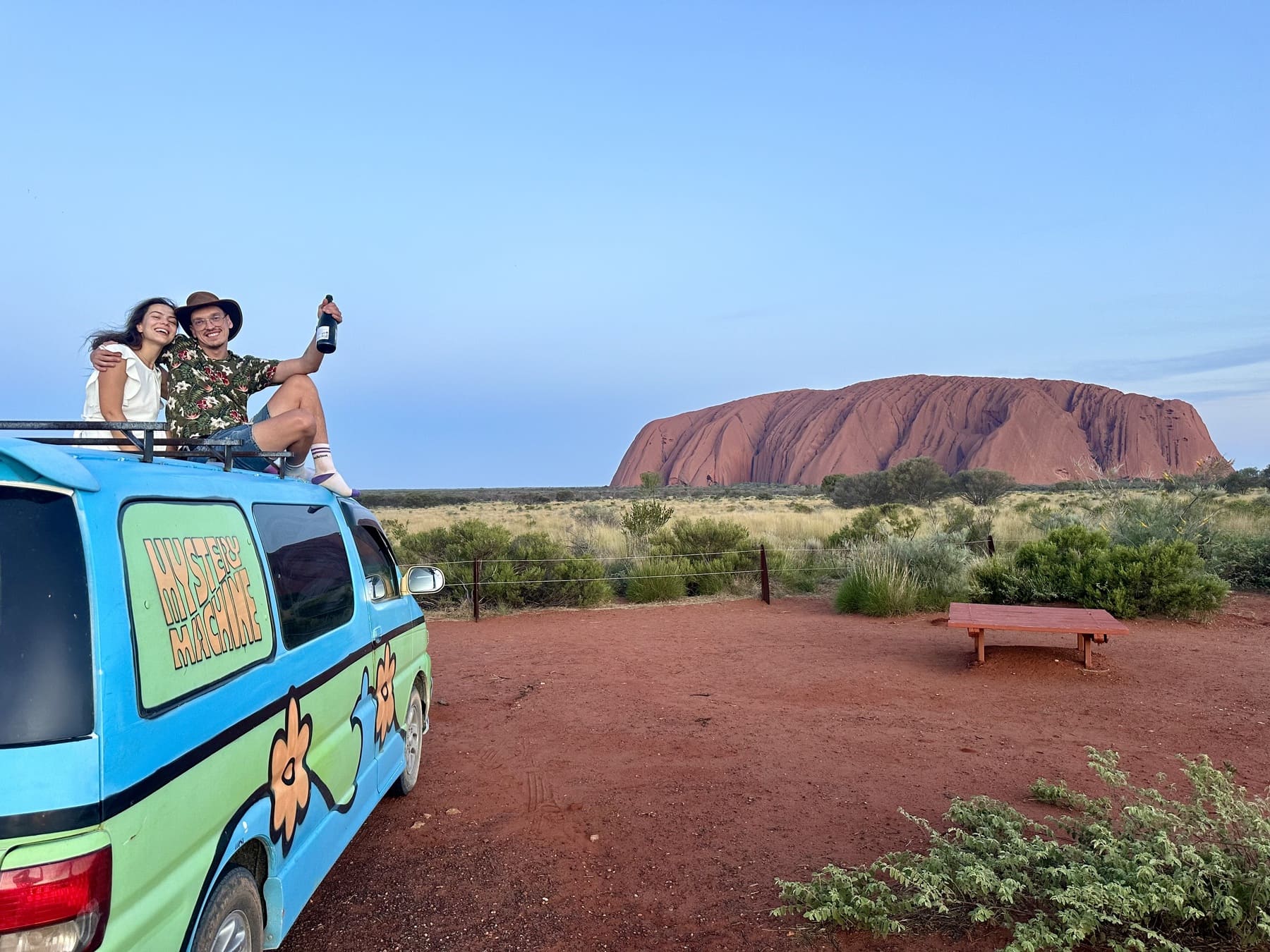
Why the viewing areas exist at all
You cannot simply stop on the road and get out. The park directs visitors to designated areas for a reason that is partly traffic and partly cultural: the ground either side of the access road includes places that are not for casual access, and the car parks are placed where they are so that people do not wander into them looking for a better angle.
That makes the choice of area a real decision rather than a formality. The five areas face different directions, and at sunrise and sunset that changes what you actually see.
Sunrise: the eastern areas
Sunrise works because the rock is lit from behind you as you look east. The eastern viewing areas give you the face coming out of shadow, and the colour arrives progressively rather than all at once — first a dull brown, then the red, then a brief period where the fluting shows real depth.
Arrive before first light, not at it. The car parks fill in the cooler months, and the walk from a distant space costs you the first minutes, which are the ones that matter. This is also the reason a flying into Sydney to pick up a campervan itinerary needs a night at Yulara before the first morning: nobody drives in overnight and enjoys a 5am start.
Sunset: the western areas and the car rule
Sunset is the busier of the two, and the park manages it with a rule that catches people out: at the main sunset viewing area, only cars are admitted — not campervans, not buses, not vehicles over a certain size. If you are travelling in something larger, you use a different area, and you want to know that before you are queued at the entrance with the light going.
The trade is worth making deliberately rather than by accident. The western areas are quieter, the view is of a different face, and you are not competing for a space with a hundred other vehicles arriving in the same ten minutes.
The twenty-minute problem
Almost everyone overestimates how long the colour lasts. The intense red period at either end of the day runs for roughly twenty minutes, and it is bracketed by light that is merely good. Photographers who arrive with a plan get more out of it than people who arrive and then decide what to do.
The practical consequence is that you should not plan to do two things in the same window. Sunset at the rock and dinner at the resort do not fit together comfortably, and trying to fit them is how people end up leaving at the exact moment the colour peaks.
Sleeping close enough to make it work
Both ends of the day reward being near the park, which is the argument for staying at Yulara rather than driving in from further out. There is no camping inside the park boundary, so Yulara — just outside it — is the practical base, and a a campervan that doubles as the accommodation removes the check-in and checkout that otherwise eat the hour before sunrise.
If you are only in the Centre for two nights, do sunrise once and sunset once and accept that the middle of the day is for the base walk, the Cultural Centre, or doing very little. Trying to catch three sunrises in two nights is how a trip to see the rock turns into a trip spent driving to it.
Questions people ask
How many viewing areas are there at Uluṟu?
Five designated areas, all signposted and all reached by sealed road. They face different parts of the rock and suit different times of day.
Can you take a campervan to the sunset viewing area?
Not to the main sunset area, which admits cars only. Larger vehicles use one of the other designated areas. The restriction is signposted at the turn-off and enforced at the entrance.
How long does the colour last?
About twenty minutes of genuinely intense colour at either end of the day. Arrive early rather than planning to catch it on the way to something else.
Do you need a park pass to use the viewing areas?
Yes. The viewing areas are inside Uluṟu-Kata Tjuṯa National Park, so the park pass applies. It is bought online in advance rather than at a gate.
Where this came from
- Parks Australia — sunrise and sunset viewing
- Parks Australia — access and alerts
- Parks Australia — visitor pass
Distances, surfaces, permit rules and park hours change. Check the authority above before you rely on any of it for a specific date.